
Julie Hulme, Professor of Psychology Education, and Rose Gann, Professor of Politics Education, Nottingham Trent University
One of the best things about #ANTF2025 was hearing about the diverse scholarship projects happening within the National Teaching Fellow (NTF) and aspiring NTF community. It didn’t surprise us – it’s the same every year! (Roll on 2026 in Newcastle…).
It did, however, mean that our workshop on our new ‘Description of Activities Relating to Scholarship in Higher Education’ (DARSHE) framework was particularly meaningful. As two senior education-focused academics, we are acutely aware of the challenges faced by many education-focused colleagues around developing expertise in teaching and learning, and so building a scholarship profile to climb the career ladder. What exactly do we need to do to gain recognition for scholarship?
One of the main reasons that we can see for the lack of clarity around scholarship in Higher Education is the repeated narrative that definitions of scholarship are contested (Trigwell, 2013). Ironically, Trigwell himself suggested that we needed to stop arguing about different definitions, and instead to recognise the purpose of scholarship, which he identified as being about the improvement of higher education. However, the debate around definitions can and does have a real impact – especially when it comes to recognition and promotion of academics on the education-focused career track. The lack of a clear definition can be used as an excuse by those responsible for academic promotions systems: “We don’t know what scholarship is, so how can we create clear promotions criteria for it?”.
In creating the DARSHE, we set out to move beyond this debate. We drew on the literature, on our own lived experiences, and on structured conversations with colleagues, to create a synthesised conceptualisation of scholarship, which is suitably flexible to incorporate a whole host of different approaches. If you describe yourself as a SoTL practitioner, an action researcher, a pedagogic researcher, an educational innovator, an androgogue…or whatever! – we believe the DARSHE will have value and meaning for you.
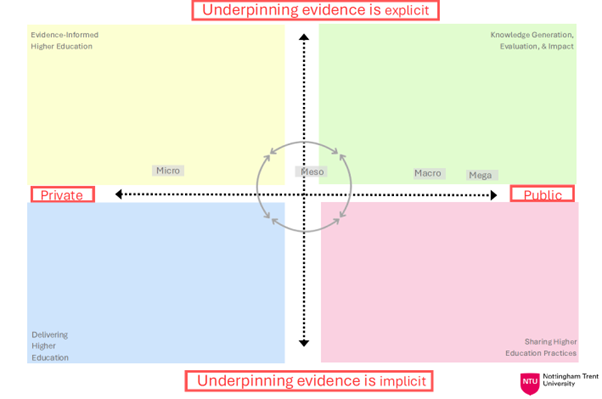
The framework itself comprises a visual ‘map’, onto which we can locate all the activities that we engage in that either comprise or are related to scholarship of higher education. This results in a structure with four quadrants (see Figure 1): Delivering Higher Education; Evidence-Based Higher Education; Knowledge Generation, Evaluation, and Impact; and Sharing Higher Education Practices.
At the symposium, we gave everyone a handout featuring the DARSHE framework, and encouraged attendees to map their own scholarship activity, and to reflect on the extent to which their work covered all four quadrants, or was localised in just one or two areas. Areas that were less well covered were identified as opportunities for development. We then asked delegates for feedback on how this worked for them as a tool for reflection.
The feedback we received was overwhelmingly positive, and informed the amendments we made in our recently published DARSHE paper . Thank you to everyone for your ideas! Now that the paper is out in the wild, we hope to see scholarship in all its diverse forms communicated in different ways to different audiences, and being valued to the benefit of everyone involved in higher education. Let’s stop arguing about definitions, and just get on with doing and sharing scholarship!
If you’d like to know more about the DARSHE and how you might use it to support your own reflections or those of your colleagues, please feel free to get in touch with us at julie.hulme@ntu.ac.uk or rose.gann@ntu.ac.uk.
Figure 1:
The DARSHE framework: Gann & Hulme (2025) propose that in undertaking good scholarship, we should aim to engage with all four quadrants. Scholarship often starts and ends with our teaching and related work, it draws on evidence from the literature and other expert sources, it is tested through evaluation and project work, and it is communicated to different audience types through academic and non-academic (e.g. media) dissemination methods. As such, we can move through different quadrants of the framework, increasing reach and impact of scholarship. Adapted with permission from Gann & Hulme (2025).
References:
Gann, R.J. & Hulme, J.A. (2025). Scholarship reimagined: Creating the DARSHE, an inclusive and flexible model for scholarship in higher education. Higher Education. https://doi.org/10.1007/s10734-025-01562-5
Trigwell, K. (2013). Evidence of the Impact of Scholarship of Teaching and Learning Purposes. Teaching & Learning Inquiry: The ISSOTL Journal, 1(1), 95–105. https://doi.org/10.2979/teachlearninqu.1.1.95

