
Prof Julie Hulme, Professor of Psychology Education, Nottingham Trent University, and Deputy Chair of the Committee of the Association of National Teaching Fellows
Prof Rose Gann, Professor of Politics Education & Head of Academic Scholarship School of Social Sciences, Nottingham Trent University
The number of people employed in education-focused roles within the UK higher education sector is growing, prompting the emergence of a ‘teaching and scholarship’ (or some equivalent) career pathway. Our recent ‘Mapping Scholarship’ project (Gann & Hulme, 2023) demonstrated that despite the growing prevalence of such roles, some staff are uncertain about what ‘counts’ as scholarship – whilst they may nevertheless be engaging in activities relating to higher education (Trigwell, 2013), that are or could be public, evaluated, and impactful (Shulman, 1999), and so could be considered as ‘scholarship’ in broad terms.
In our Mapping Scholarship workshops, we introduced colleagues to Kern et al.’s (2015) Dimensions and Activities Related to Teaching (DART) model (see Figure 1), encouraging staff to reflect on which sorts of activities they regularly engaged in, and whether they considered them as aspects of scholarship. The DART model proved immensely useful for stimulating discussion and raising staff awareness, and provoked considerable debate around the question of the nature of scholarship.
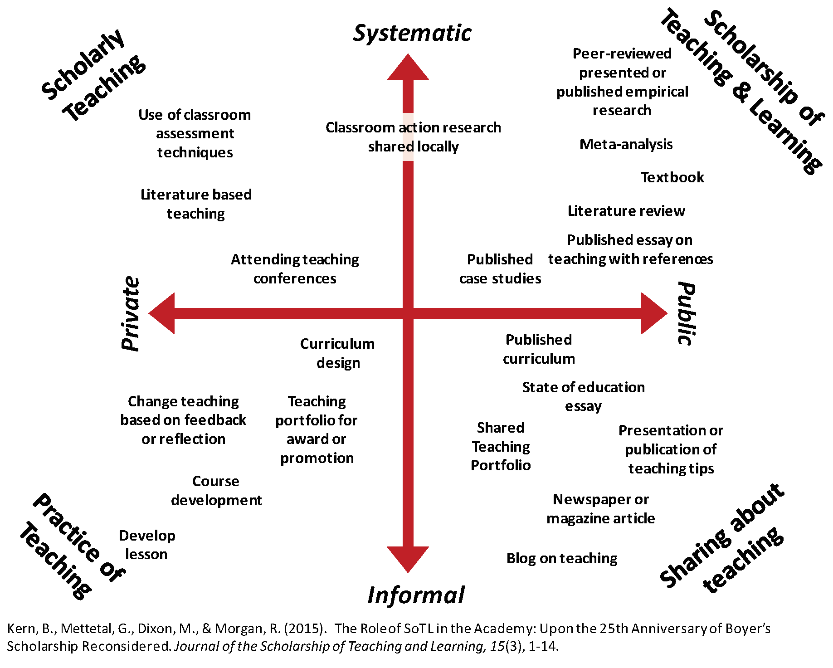
Figure 1: Dimensions and Activities Related to Teaching, taken from Kern et al. (2015).
However, despite its usefulness, some colleagues also found the DART model alienating and problematic. These colleagues were accustomed to working in the bottom left (private, informal) quadrant, with a focus on the practice of teaching, and in the upper left (private, systematic) quadrant, with a focus on scholarly teaching. Staff felt that these activities were important and directly supportive of students, and that they should be given more recognition by their employer but also within debates relating to scholarship and within the DART model itself. Likewise, staff felt that activities in the bottom right quadrant (public, informal) that related to sharing about teaching were under-valued by the DART model – as the key goal or place to aspire to within this model seemed to be the top right (public, systematic) quadrant, relating to the scholarship of teaching and learning (SoTL). As a result, some colleagues felt that the DART model privileged or prioritised an understanding of scholarship in which being systematic, and public, counted for more than the other types of scholarship practiced informally and in private. This privileging of public and systematic scholarship was problematic not just because it added a hierarchal ordering into to understandings of scholarship, but also because it could be seen as a reiterating some of the values of the dominant research culture in universities, and thus promoting elitist rather than inclusive practices. In addition, some activities included in the model by Kern et al. (2015) were out-dated and/or misplaced – fitting better in quadrants other than those in which they had been originally place in the DART model.
This led us to interrogate the DART model, reflecting upon these discussions, on our own conceptualisations of scholarship, and the ways in which scholarship is practiced and recognised within our networks and communities across the higher education sector. We noted we often start with activities recognised within DART as the practice of teaching, and in the process of seeking to improve or enhance learning for our students, we move around the different quadrants as we search for answers. We search the literature, sometimes attend conferences, and seek advice from colleagues to inform our practices, and then try out innovations based on what we find (scholarly teaching). Sometimes, our next step is to share our reflections on this relatively informally, in meetings with our colleagues for example, or via a departmental newsletter (sharing about teaching). Sometimes, we are more confident in our innovation and its evaluation, and publish a journal article, or attend a national conference to present our findings (scholarship of teaching and learning). Often, we receive feedback from peers as we share, and we take this back to our classrooms, to refine our ideas (scholarly teaching and practice of teaching again). As a result, the practice of scholarship often involves an iterative process, rather than a linear development culminating in a SoTL project and outputs.
Instead of neatly fitting into a single quadrant, our findings from discussions with colleagues, and our own reflections, suggest that scholarship is a dynamic process that frequently involves moving between quadrants. Some activities can locate across multiple quadrants: for example, the creation of teaching resources could be a form of the practice of teaching, but if informed by knowledge from the literature, it becomes scholarly teaching. If the resources are shared publicly, for example on the National Teaching Repository, the activity then turns into the sharing of teaching. Eventually, with sufficient evaluation, if sufficiently innovative and impactful, a pedagogic journal article may follow, based on the uses of the resource.
Whilst we found the DART model and the setting out of different practices and activities relating to teaching extremely useful in helping staff to engage with and better understand how they themselves engage with the practice of scholarship we also became aware of considerable limitations of the DART model. We are therefore currently working on a revised model of scholarship that builds upon the DART model, but which features this more dynamic approach. We suggest that in recognising the ways in which scholarship activities develop and shift in focus, we necessarily engage with a broad range of activities within the definition of scholarship (rather than SoTL only) and by so doing we open-up a more inclusive approach which will empower and enable education-focused staff (and others) to share their experiences and expertise to the benefit of the wider academy.
References:
Gann, R., Hulme, J. 2023. Mapping Scholarship in a large School of Social Sciences: sharing our approach and initial findings from this project, Association of National Teaching Fellows Blog, www.ntf-association.com
Kern, B., Mettetal, G., Dixson, M. and Morgan, R.K., 2015. The role of SoTL in the academy: Upon the 25th anniversary of Boyer’s Scholarship Reconsidered. Journal of the Scholarship of Teaching and Learning, pp.1-14.
National Teaching Repository, https://ntrepository.com/about/ accessed 15 June 2024
Shulman, L. S. (1999) ‘Taking Learning Seriously’, Change: The Magazine of Higher Learning, 31(4), pp. 10–17. doi: 10.1080/00091389909602695.
Trigwell, K., 2013. Evidence of the impact of scholarship of teaching and learning purposes. Teaching and Learning Inquiry, 1(1), pp.95-105.
Image: Newton Building, Talbot Street, Nottingham © Copyright Stephen Richards and licensed for reuse under this Creative Commons Licence.
X (formerly Twitter): Follow @RosejGann and @JulieH_Psyc for more information about this project

