
Professor Lisa Taylor PhD MSc BSc (Hons) NTF SFHEA – Professor of Employability and Learning Innovation, University of East Anglia
More than 70% of graduates still work from home one or two days a week (Institute of Student Employers, 2023) with 55% of Gen Z graduates preferring hybrid work (Kashyap, 2023). Graduates need to be prepared for an online world of work, as a different set of employability skills and attributes are needed (Hughes and Thambar, 2023).
Employability is one of the critical priorities within the higher education landscape across the world (Abelha et al., 2020) with placements being the most common employability activity (The Association of Graduate Careers Advisory Services and Shortlist Me, 2022) and recommended as a part of each student’s higher education journey (Pitt and Quinlan, 2022). However, placements can be seen as an inferior “add on” to the academic curriculum with a perceived lack of pedagogical design and delivery.
Traditional lengthy placements within industry can be burdensome for students (Hayes and Cejnar, 2020), and travel and accommodation costs can limit accessibility for all students (Thompson and Brewster, 2022). Online delivery of placements can remove some of these barriers, with a more flexible and accessible approach of delivery in many cases (Gamage, 2021; Sophonhiranrak, 2021).
The award-winning innovative Peer Enhanced e-Placement (PEEP) model (Erasmus+, 2023) is a quality, pedagogically robust, evidence based, sustainable online placement option, recognised by professional and statutory bodies (Council of Deans of Health, 2022) and recommended within recent Higher Education Commission Policy Connect report for consideration across the higher education sector “in our view, this type of activity could and should be expanded in a similar guide across disciplines” (Policy Connect, 2024 Page 30).
The PEEP harnesses robust evidence-based online (Salmon, 2011) and peer-learning pedagogy (Tai et al., 2021; Topping et al., 2017), built around placement learning outcomes (“anchors”) and professional placement learning standards. The key pedagogical design and delivery principles for a PEEP include (Taylor, 2023):
• Clear and common purpose through learning outcomes (“anchors”);
• Scaffolded online learning based on the Five Stage Model (Salmon, 2011);
• Support cognitive and social constructivism through peer group work, to underpin agency of students and the metacognition of their learning (Lidster and Wakefield, 2022);
• Engagement in learning facilitated through supervision, assessment, feedback and reflection;
• Clear roles and responsibilities for all involved;
• Building relationships and mutual understanding between higher education, students and employers, and
• Application of universal design for learning (UDL) principles https://udlguidelines.cast.org/
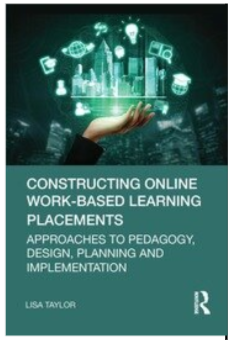
A book has been written based on the design and delivery principles of a PEEP (Taylor, 2023).
Formal evaluations of the PEEP demonstrate improved team working, communication and in-depth critical reasoning as well as readiness for online workplace contexts. The collaborative approach for a PEEP’s design and delivery, develops a mutual understanding of needs for everyone involved, resulting in learning outcomes and activities of a PEEP being designed to bridge identified gaps between higher education and employment.
The world of work is changing to more online blend of work. Placements need to respond to this change to facilitate graduate online work readiness. The pedagogical journey through placements needs to be designed and delivered to provide quality learning experiences. The PEEP offers an online evidence-based pedagogically robust placement option to address this need.
References:
Abelha, M, Fernandes, S, Mesquita, D, Seabra, F, and Ferreira-Oliveira, A. (2020) Graduate employability and competence development in higher education—A systematic literature review using PRISMA. Sustainability, 12(15), 5900. https://doi.org/10.3390/su12155900
Council of Deans of Health. (2022). Pandemic powered improvements Best practice in innovative healthcare education placements created during the pandemic. Council of Deans of Health.
Erasmus+ (2023) Employability in Programme Development https://www.gla.ac.uk/research/az/epd/case%20studies/#researchoutcomes%2Ccollatedcasestudies
Gamage, A (2021): An inclusive multifaceted approach for the development of electronic work-integrated learning (eWIL) curriculum, Studies in Higher Education, DOI: 10.1080/03075079.2021.1894116
Hayes, M. and Cejnar, L. (2020) Evaluating Alternative Work-Integrated Learning Opportunities: Student Perceptions of Interdisciplinary Industry-Based Projects, International Journal of Economic & Administrative Studies, 17(4), pp. 1–12.
Hughes, H, Thambar, N (2023) The impact of hybrid working on graduate careers Prospects Luminate https://luminate.prospects.ac.uk/the-impact-of-hybrid-working-on-graduate-careers
Institute of Student Employers (2023) Do young people like hybrid and remote work? Institute of Student Employers https://insights.ise.org.uk/development/blog-do-young-people-like-hybrid-and-remote-work/
Kashyap, K (2023) Future of Work – 55% of Gen Z graduates of Class 2023 prefer remote or hybrid work Spiceworks https://www.spiceworks.com/hr/future-work/articles/gen-z-graduates-prefer-remote-or-hybrid-work/
Lidster, J and Wakefield, S (2022) Student Practice Supervision & Assessment Learning Matters 2nd Edition A SAGE Publishing Company
Pitt, E, Quinlan, K (2022) Impacts of Higher Education Assessment and Feedback Policy and Practice on Students: A Review of the Literature 2016-2021. Advance HE.
Policy Connect (2024) Digitally enhanced blended learning: Leveraging the benefits of technology in higher education. Policy Connect https://www.policyconnect.org.uk/research/digitally-enhanced-blended-learning-leveraging-benefits-technology-higher-education
Salmon, G. (2011). E-moderating: The key to teaching and learning online (3rd ed.). New York: Routledge.
Sophonhiranrak, S (2021) Features, barriers, and influencing factors of mobile learning in higher education: A systematic review, Heliyon, Volume 7, Issue 4, 2021, e06696, ISSN 2405-8440, https://doi.org/10.1016/j.heliyon.2021.e06696
Tai, J, Penman, M, Chou, C, Teherani, A (2021) “Learning with and from peers in clinical education” In Nestel, D, Reedy, G, McKenna, L, Gough, S (Eds) Clinical Education for the Health Professions. Springer, Singapore.
Taylor, L. (2023) Constructing Online Work-Based Learning Placements: Approaches to Pedagogy, Design, Planning and Implementation. Routledge. https://doi.org/10.4324/9781003315872
The Association of Graduate Careers Advisory Services, Shortlist Me. (2022). The evolution and integration of careers and employability education in universities. The Association of Graduate Careers Advisory Services, Sheffield, UK.
Topping, K, Buchs, C, Duran, D, Van Keer, H (2017) Effective Peer Learning – From principles to practical implementation. Taylor and Francis Group.
More information: Email Lisa.Taylor@uea.ac.uk; X (Twitter) @drlisataylor; LinkedIn https://www.linkedin.com/in/professor-lisa-taylor-10010464/
Image: Image by This_is_Engineering from Pixabay

